Conversion
How to improve CR of your Facebook ads
A higher conversion rate is cheaper than more traffic. Where the biggest funnel wins on Facebook hide.
Scaling Facebook Ads is not the same as raising a budget and hoping for the best. Real scaling means increasing ad spend on Meta in a controlled way while keeping ROAS (return on ad spend) and CPA (cost per acquisition) at or near target levels. Advertisers who scale without a system usually see costs climb and returns fall within days. This guide lays out a data-driven scaling strategy: when to scale, which unit economics to check first, how vertical and horizontal scaling differ, which budget rules protect campaign performance, how creative testing and audience expansion fuel growth, which performance metrics to watch, the most common mistakes, and how to turn all of it into a repeatable long-term system.
Table of Contents
Facebook Ads scaling is the process of growing results — conversions, revenue, and reach — proportionally to ad spend or better, without a meaningful decline in efficiency. If a campaign spends $100 per day at a $25 CPA, successful scaling might mean spending $500 per day at a CPA of $25–$28, not $45.
The difference between scaling and simply raising a budget lies in control. A blunt budget increase pushes Meta’s delivery system into more expensive auctions and less responsive audience pockets, and campaign metrics often deteriorate. Strategic scaling relies on incremental expansion, guided by performance signals rather than guesswork.
That process only works on a solid foundation: stable metrics over several days, healthy unit economics, and systematic changes to budget, creatives, and audiences made one lever at a time. Without those three elements, more ad spend usually buys less efficiency.
Timing is one of the most underrated parts of any scaling strategy. Premature budget increases on ad campaigns that have not yet stabilized tend to amplify existing problems rather than results. The two checklists below help advertisers decide whether a campaign is ready.
A campaign is usually ready for more ad spend when most of these conditions hold at the same time:
When these signals line up, the ad set has proven that it can convert efficiently, and additional budget has a strong chance of producing proportional results.
Some performance signals indicate that more budget would only accelerate losses:
In these cases, the right move is to fix the underlying issue — creative, offer, audience, or unit economics — before touching the budget.
Unit economics describe how much a business earns or loses on each customer. Before scaling Facebook Ads, advertisers need to know three numbers in plain terms. CAC is the total cost of acquiring one customer. LTV is the revenue a customer is expected to generate over the whole relationship. MER (marketing efficiency ratio) is total revenue divided by total ad spend across all channels — a blended metric that captures conversions platform-reported ROAS misses.
Positive unit economics is non-negotiable. If CAC is already close to LTV at a small budget, scaling will push CAC higher and turn a marginal campaign into an unprofitable one. Contribution margin — revenue minus product costs, shipping, fees, and ad spend — shows whether growth actually produces profit.
| Metric | Definition | Ideal Value | Impact on Scaling |
|---|---|---|---|
| CAC | Cost to acquire one customer | Lower than LTV | If CAC rises too much, scaling reduces profitability |
| LTV | Revenue expected from a customer over time | Should be > 3x CAC | Higher LTV allows higher CAC levels |
| ROAS | Return on ad spend (revenue / ad spend) | > 4 (varies by margin) | ROAS drop during scaling indicates inefficiency |
| MER | Total revenue / total ad spend | > 2–3 (depends) | Blended metric accounts for indirect conversions |
An LTV:CAC ratio of 3:1 or better gives a brand room to accept a slightly higher CAC as spend grows, which is exactly what tends to happen during sustainable growth.
Every scaling strategy on Meta falls into one of two models. Vertical scaling means putting more budget behind proven ad sets. Horizontal scaling means creating new ad sets that reach new audiences, placements, or ad formats. The right choice depends on campaign maturity and how much audience remains available: a young campaign with one winning ad set and low frequency suits vertical scaling, while a mature campaign facing audience saturation needs horizontal expansion.
| Aspect | Vertical Scaling | Horizontal Scaling |
|---|---|---|
| Method | Raise budget on proven ad sets | Add new audiences, creatives, or placements |
| Risk | May saturate audience, increase frequency | Spreads spend, may dilute performance |
| Best for | Solid audiences with low frequency | When scale is limited by audience size |
| Budget rule | Incremental increases (20–30%) | Use separate campaigns or ad sets |
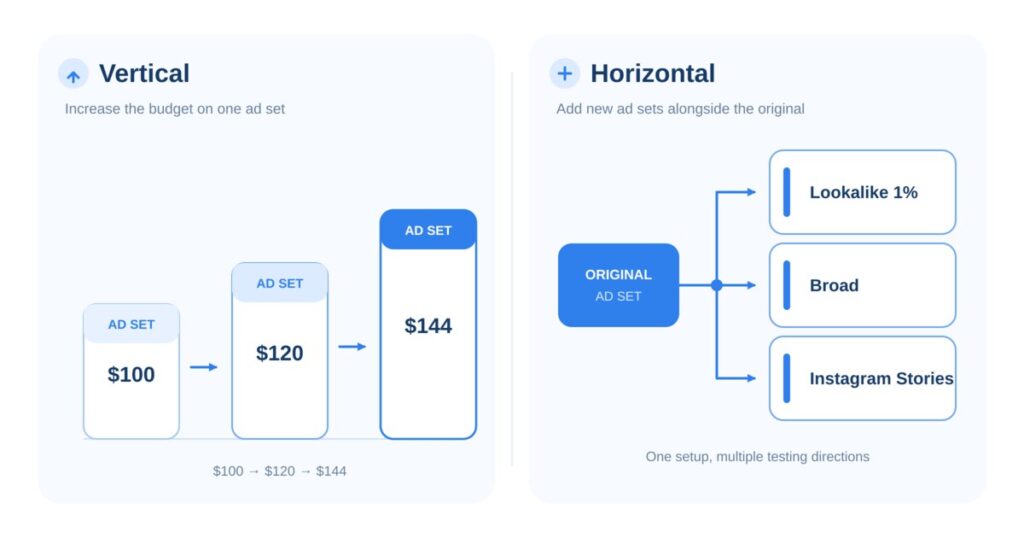
The core vertical tactic is gradual budget increases: raise the budget on a winning ad set by 20–30% every 48–72 hours. This pace lets delivery adjust without a full learning phase reset. Advertisers who want to move faster can duplicate ad sets and launch the copy at a higher budget, leaving the original untouched as a safety net.
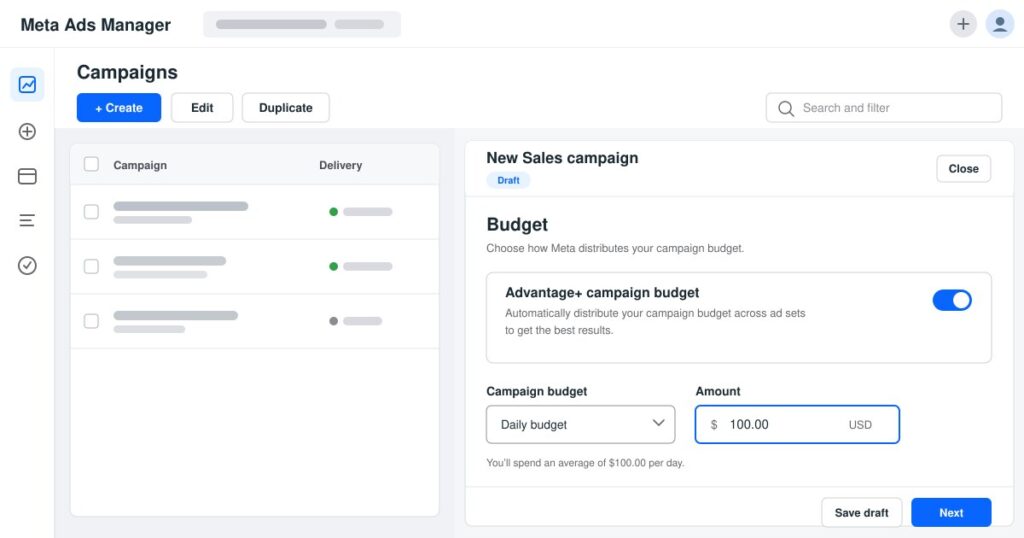
Advantage+ campaign budget (formerly campaign budget optimization, or CBO) is another vertical lever: raising the campaign-level budget lets Meta distribute additional spend across the ad sets most likely to convert. Throughout the process, it is essential to monitor frequency and CPA; if frequency climbs past 3 or CPA rises more than 15–20% above target, the budget should hold steady until metrics recover.
Horizontal scaling widens the pool of people who see the ads. Audience layering combines interests, behaviors, and demographics into new segments. Lookalike Audiences built from purchasers open fresh, high-intent pockets, while new interest targeting tests adjacent customer profiles.
Placement expansion is equally valuable: a campaign that performs in the Facebook Feed may find cheaper conversions in Instagram Stories, Reels, or Audience Network. Testing new ad formats such as video and carousel, along with new creative angles, helps each new segment receive a relevant message. Exclusions should be applied to every new ad set so that segments do not compete with each other in the same auctions.
Budget discipline separates stable growth from volatility. Meta treats large budget edits as significant changes, so aggressive jumps often send an ad set back into the learning phase, where costs are higher and results are unpredictable. The following rules keep budget allocation under control:
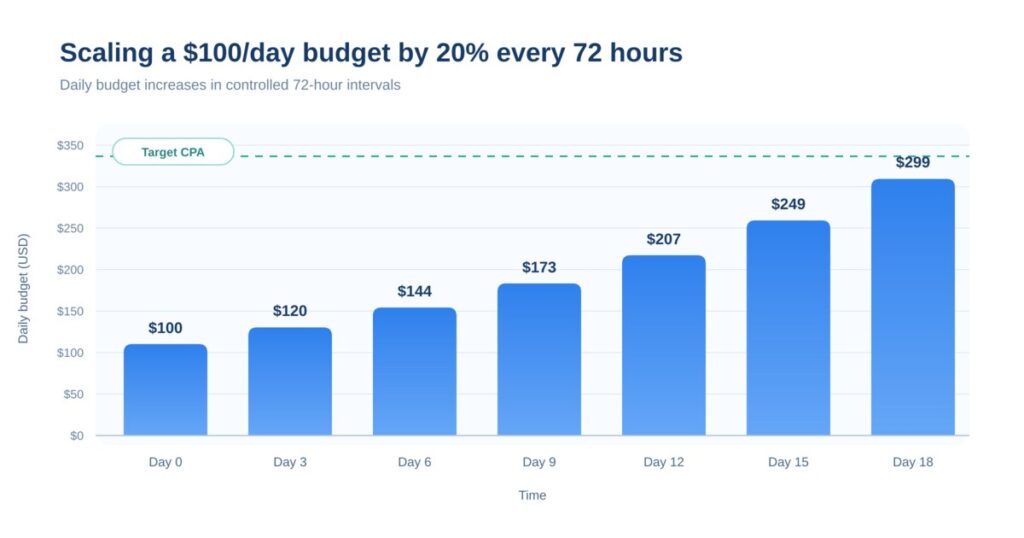
“Increase budget by no more than 20–30% every 48–72 hours.”
Following this cadence, a $100 daily budget grows to roughly $300 within about three weeks through incremental increases of 20%, with each step validated by data.
Advantage+ campaign budget — the current name for what Meta long called CBO — sets one budget at the campaign level and automatically shifts spend toward the ad sets with the best predicted results. It works well when a campaign contains multiple winners and simplifies management as the account grows.
ABO (Ad Set Budget Optimization) assigns a fixed budget to each ad set, giving the advertiser manual control. It suits situations where one or two specific ad sets clearly outperform the rest, and it prevents the algorithm from over-allocating spend to weak ad sets. Many media buyers test in ABO and then scale proven ad sets under Advantage+ campaign budget.
Creative fatigue is the main barrier to scaling Facebook Ads. As budget grows, the same people see the same ads more often, CTR falls, and CPA rises. A steady pipeline of fresh ad creatives is what allows spend to keep growing. A practical creative testing framework has five steps:
This loop turns creative testing into a scaling multiplier: each new winning creative extends the life of an audience and supports higher budgets.
Effective tests cover five areas. Ad copy includes headlines and primary text. Visuals range from static images to videos of different lengths and aspect ratios, such as 1:1, 4:5, and 9:16. Offers include discounts, bundles, and free shipping. Ad formats include carousel, collection, and single image. Ad angles include pain points, benefits, and social proof such as reviews and testimonials.
Each test should isolate one variable and use A/B testing with proper attribution, so the result reflects the creative itself rather than differences in audience or placement.
Warm segments such as website visitors and past purchasers are the most profitable, but they are small. Retargeting alone rarely supports large budgets, so audience expansion becomes necessary. The main strategies include:
Audience overlap is the hidden cost of expansion. When several ad sets target the same people, they bid against each other, raising CPM and wasting budget. Clear exclusion logic keeps each segment separate.
The quality of a lookalike depends on its source. The strongest Lookalike Audiences come from high-value sources such as purchasers, high-LTV customers, or add-to-cart events tracked by the Meta Pixel. Advertisers should start with a 1% lookalike, which most closely matches the source, then test 2–3% audiences for scale once the 1% version performs.
Source audiences should be refreshed regularly — monthly is a common cadence — so the lookalike reflects recent buyers. Combining lookalikes with exclusions of existing customers keeps spend focused on new acquisition.
Broad targeting works best when a product has wide appeal and the Meta Pixel has already collected substantial conversion data. In that situation, the algorithm often finds buyers more efficiently than narrow interest targeting, which can lower CPA.
The trade-off is that broad targeting in smaller markets may raise frequency on a limited audience size. It is typically most effective after retargeting and lookalike campaigns have proven success and fed the pixel with clean purchase signals.
Scaling decisions should rest on daily tracking of a small set of performance metrics. Each metric has a normal range and a red flag that signals when to slow down.
| Metric | Definition | Normal Range | Red Flag During Scaling |
|---|---|---|---|
| ROAS | Revenue / ad spend | > 3–4 (depends) | Sustained drop below target |
| CPA | Cost per conversion | Varies | Rising CPA without volume increase |
| Frequency | Average exposures per user | 1–3 | Frequency > 4 signals audience fatigue |
| CPM | Cost per 1,000 impressions | $10–20+ in the US (higher in Q4 and competitive niches) | Rising CPM without better performance |
| CTR | Click-through rate | 1–2% | CTR below 1% or a steady decline indicates creative fatigue |
| Conv. Rate (purchase) | % of clicks that result in a purchase (ecommerce) | 1–3% | Drop suggests audience, offer, or landing page issues |
| Conv. Rate (lead gen) | % of clicks that result in a submitted lead | 5–10%+ (higher for instant forms) | Drop suggests weak offer or form friction; watch lead quality too |
| MER | Total revenue / total ad spend | > 2 | Falling MER means scaling cuts efficiency |
Advertisers should review these numbers daily and adjust the scaling pace as soon as a red flag appears. A single bad day is noise; two or three consecutive days of decline call for pausing budget increases.
Most failed scaling attempts come down to a handful of repeat errors, each with a clear fix:
Avoiding these mistakes does more to protect return on ad spend than any single advanced tactic.
Sustainable Facebook Ads scaling is a process, not a one-time push. A repeatable scaling workflow gives teams a consistent routine that compounds results over time:
Teams that follow this system replace guesswork with data-driven decisions and turn scaling into a path to continuous growth.
Even a well-built scaling system can hit a ceiling that has nothing to do with creatives or audiences: the ad account itself. New and standard Meta ad accounts start with spending limits that rise gradually with payment history, and they are more exposed to declined payments, verification checks, and sudden restrictions at exactly the moment spend accelerates. For advertisers planning to grow from hundreds to thousands of dollars per day, account infrastructure becomes part of the scaling strategy.
Agency ad accounts are Meta ad accounts issued through advertising agencies, often Meta Business Partners or authorized resellers. The advertiser runs campaigns as usual, while the agency provides the account and handles billing. For scaling, they typically offer:
| Aspect | Standard Ad Account | Agency Ad Account |
|---|---|---|
| Spending limit | Starts low, grows with payment history | High or unlimited from day one |
| Payment | Advertiser’s own card or local methods | Prepaid top-ups via agency, multiple methods |
| Support | Standard Meta support channels | Agency manager plus escalation to Meta |
| Risk during rapid scaling | Higher chance of payment and verification issues | Lower, backed by account history |
| Cost | No extra fees | Service fee, usually a percentage of ad spend or top-ups |
Agency accounts do not exempt advertisers from Meta’s Advertising Standards: ads and landing pages are still reviewed, and policy violations still lead to restrictions. When choosing a provider, it is worth checking official partner status, the fee structure, top-up speed, support response time, and terms for refunding unspent balance. Agency accounts make the most sense once daily spend approaches the limits of an existing account or when a business manages several brands or markets at once.
Need account infrastructure that keeps up with your spend? Explore Facebook agency ad accounts →
The safest range is 20–30% every 2–3 days. This pace grows spend steadily while minimizing the risk of a learning phase reset.
Only when performance has been stable for 3–5 days. Scaling on a single strong day often leads to disappointment once results normalize.
Advantage+ campaign budget (formerly CBO) is the simplest option because it distributes budget to the strongest ad sets automatically. Manual scaling with ABO also works, but each ad set should be monitored separately.
Keep budget increases within 20–30% and avoid editing targeting, creatives, and budget at the same time. Each significant change can restart learning.
Pause further increases, reduce the budget to the last stable level, and investigate frequency, CPM, and CTR to find whether audience saturation or ad fatigue is the cause.
Vertical scaling is usually simpler for beginners with one winning ad set, since it requires fewer moving parts. Horizontal scaling becomes important once that audience starts to saturate.
Scaling Facebook Ads successfully comes down to patience, clean data, and a disciplined system. Advertisers who respect unit economics, grow budgets incrementally, and keep creatives and audiences fresh can increase ad spend while protecting ROAS for the long term.